England facing a succession crisis.
The night before

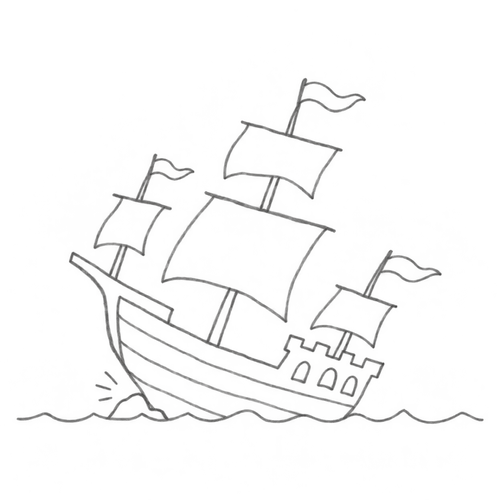
On 25 November 1120, a party set sail from Barfleur in Normandy. Its passengers included William Adelin, the seventeen-year-old son and heir of Henry I, along with a large part of the royal entourage.

There were around 300 people aboard the White Ship. By morning, only one survivor was said to be left clinging to the wreckage.
The scene almost invites a modern comparison: a royal party, a newly refitted ship, a crowd of young nobles and a night out that has run well past the point when someone sensible should say, “Let’s take the other boat.” That is, essentially, what Henry had done. The party aboard the White Ship apparently expected their faster vessel to catch up with the king’s. It did not.
The chroniclers describe drinking and disorder aboard. Some accounts say the ship’s crew wanted to catch up with the king’s vessel. Soon after leaving Barfleur, the White Ship struck a rock and began to sink. The precise details come from medieval writers, not a ship’s log, so they deserve a little caution. But the central disaster is clear: the ship went down, and almost everyone aboard died. Whatever the crew’s plan for a speedy crossing, the rock had other ideas.
Henry I had made other arrangements for his own crossing. His son and the royal party stayed behind, apparently expecting the faster White Ship to make up the time. It did not.
The man who stayed ashore
One passenger who did not sail was Stephen of Blois, Henry’s nephew and a future king of England.
The accounts vary over why Stephen stayed behind. The British Library’s summary of Orderic Vitalis says he and others refused to board after seeing how drunk and unruly the company had become. Other retellings give him a stomach complaint: a spectacularly unheroic reason to miss a voyage, but a very effective one. Either way, he was not aboard when the ship sank.
That coincidence has invited suspicion ever since: Stephen survived the wreck and later took the throne. But survival is not evidence of a plot. The chroniclers record no credible proof that he arranged the disaster. Sometimes history hands someone the most suspicious-looking piece of luck imaginable, then declines to provide the crucial evidence. Very inconsiderate of it.
A kingdom loses its heir
William Adelin was Henry’s only legitimate son. His death was therefore a personal tragedy and a political catastrophe.
One early account, by William of Malmesbury, says that William had reached a small boat when he heard the cries of his half-sister, Matilda, Countess of Perche. He ordered the boat back to rescue her. Others tried to climb aboard, and the overloaded boat capsized. William and Matilda drowned.
Orderic Vitalis later named a butcher from Rouen, Berold, as the sole survivor. He was said to have clung to wreckage through the night. The ship’s captain, Thomas FitzStephen, also appears in Orderic’s account: he survived the initial sinking, learned that William had died, and let himself drown rather than face the king. That last detail belongs to the chronicler’s telling; it is not something we can independently verify. Medieval accounts have a flair for the dramatic, but they don’t always leave us the paperwork to check it.
The bodies of most of the dead were never recovered. The king, meanwhile, had to be told that his son was gone. Orderic describes Henry’s grief as overwhelming. Even kings, for all the crowns and clerks, are still fathers who have to absorb the same dreadful news as anyone else.
The succession problem

Henry had two legitimate children with his wife Matilda of Scotland: William and their daughter, Matilda. William’s death left his sister as Henry’s only legitimate child.
Henry remarried Adeliza of Louvain in 1121, but they had no legitimate son. In 1127, Henry required his leading barons to swear support for Matilda’s succession. An oath could record a king’s wishes; it could not guarantee that those wishes would be honoured when the crown was actually at stake. It was a promise, not a padlock.
When Henry died in 1135, his nephew Stephen claimed the throne and was crowned king. Matilda challenged him. The resulting struggle, known as the Anarchy, brought years of conflict and disorder before a settlement in 1153 recognised Matilda’s son, the future Henry II, as Stephen’s heir.
The shipwreck did not make civil war inevitable. It did, however, remove the heir around whom Henry’s plans had been built and leave the succession unsettled. A single night at sea helped turn a family tragedy into a crisis of rule. The ship sank in hours; the political consequences took rather longer to clear up.
What changed?
The White Ship disaster is sometimes told as though it were a neat chain of dominoes: shipwreck, succession crisis, civil war, and then a straight line to later queens and regents. The real story is less tidy—and history rarely lines up its dominoes quite so obligingly.
The disaster mattered because of the people lost, the uncertainty it created, and the choices made in its aftermath. Henry’s decision to name Matilda as his heir was significant; so was Stephen’s later claim and the support he gathered. The Anarchy was not simply a delayed consequence of one shipwreck. It was a political conflict shaped by competing claims, loyalties and calculations.
That makes the story more interesting, not less. The White Ship did not sink because history needed a dramatic opening act. It sank, people died, and the survivors had to decide what came next. England’s ruling family then discovered that succession planning is less reliable than it looks when the heir is still alive.
Further reading
- The White Ship: Conquest, Anarchy and the Wrecking of Henry I’s Dream by Charles Spencer
- Matilda of Scotland: A Study in Medieval Queenship by Lois Huneycutt
- The Rex Factor podcast episodes on William Rufus, Henry I and Stephen
A personal reflection
Henry I is one of my two favourite English kings. He inherited a realm left in a shambles by his brother’s reign and did much to restore the crown’s credibility. My work is deeply rooted in human-rights legislation, so it is hard for me not to respect the Charter of Liberties. It was not a modern human-rights instrument, but it set out promises about the limits of royal conduct. In the immense snowball of legal history, its contribution may be a small stone; it still helped shape the ground on which later ideas about lawful government were built.
That respect for Henry doesn’t mean I think Matilda was rejected simply because she was a woman. Her sex may well have counted against her, in a political world where power was overwhelmingly imagined as male, but it cannot explain everything. Matilda had spent much of her life at an imperial court, where power was expressed differently. Stephen was a familiar face at the English court: he knew its people, customs and unspoken rules. Familiarity can be a powerful political advantage, even when it is no guarantee of good government.
Thinking about that helps me see Henry VIII’s succession anxieties in a more complicated light. He was highly educated and would have known what had happened the last time a king died without a legitimate male heir. The chroniclers could hardly have described the years that followed more bleakly: “Christ and his saints slept.” This does not excuse Henry VIII’s terrible actions. I can see how someone might reach for the word “dictator”, though it is an anachronistic label. But explaining his concern about succession simply as sexism risks flattening the history. Sexism belonged in the picture; so did the fear of another kingdom torn apart by a disputed succession.
Then there is the bitter dynastic irony. Henry’s grief, the frantic effort to secure the succession, and years of conflict led eventually to Henry II inheriting through Matilda’s line. Had Matilda succeeded directly, her son would still have stood to inherit. The route was different, and the cost to the people caught in it was appalling; the destination may well have been the same. History occasionally writes a joke with a very long set-up and a terrible punchline.
I love the Game of Thrones-esque intrigue of the theory that Stephen sabotaged the White Ship. It is especially tempting because Stephen is remembered as an unsuccessful king, with much of his reign consumed by civil war. But I don’t believe the universe is quite so lazy as to make the most dramatically convenient conspiracy true. Stephen’s survival was suspiciously useful. That makes a fine story; it still doesn’t make it proof.
Finally, I believe there was a real link between the White Ship and the Mora, the ship Matilda of Flanders gave her husband, William, Duke of Normandy—William the Conqueror, or “Billy the Bastard” in less formal company—for his crossing to England. The family connection through the ships’ captains gives the story a thread between two famous voyages. After all the dynastic manoeuvring, wreckage and arguments over the crown, what stays with me is the human tie beneath it: a father and son, two ships, and the people who trusted them to bring them home.